

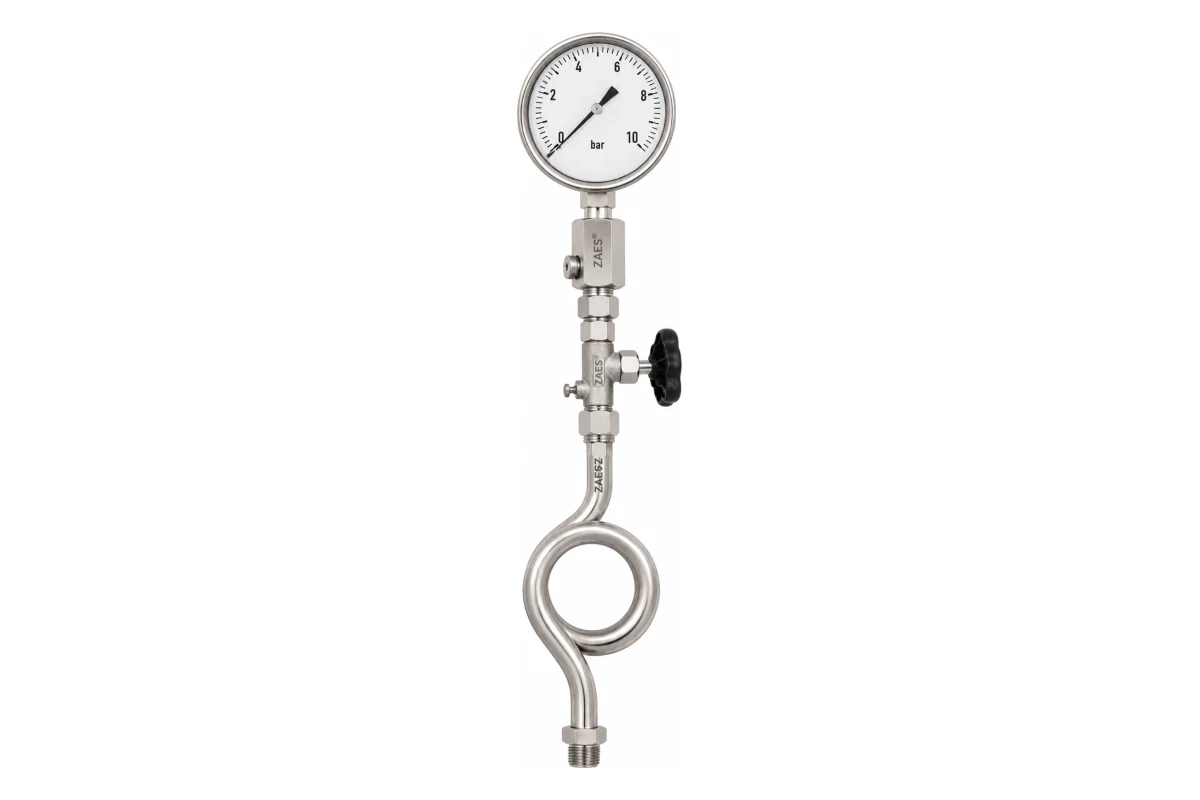
ZAES, a Spanish manufacturer of industrial instrumentation accessories, offers solutions to protect pressure gauges against pressure pulsations, water hammer and high temperatures, helping to reduce breakdowns, improve the reliability of measurements and optimise maintenance costs.
In any industrial facility, accurate pressure measurement is essential for controlling processes, protecting equipment and maintaining safe operating conditions. However, pressure gauges are constantly exposed to factors that can compromise their accuracy and shorten their service life.
Vibrations from pumps and compressors, pressure fluctuations, water hammer, high steam temperatures and the presence of corrosive fluids are some of the main causes of wear and tear on these instruments.
To tackle these challenges, METALÚRGICA ZAES, S.L., a Spanish manufacturer with over 50 years’ experience in the valves and industrial instrumentation sector, offers a range of accessories designed to improve the protection and performance of pressure measurement systems.
Among these solutions, the following stand out: pressure dampers, siphon tubes and valves for pressure gauges, components that can be installed individually or combined to suit the requirements of each process.
The aim is simple: to protect the pressure gauge, ensure reliable pressure readings and avoid premature replacements that incur unnecessary costs.
Why do industrial pressure gauges break down?
A pressure gauge may be correctly selected in terms of its pressure range, yet still suffer premature failure if process conditions are not taken into account during its installation.
The most common causes include:
- Pressure pulses: common in reciprocating pumps, hydraulic systems and compressors. They cause continuous oscillations of the needle and lead to fatigue in the internal mechanisms.
- Rammer blows: sudden changes in pressure that may be caused by the rapid closure of valves or sudden changes in flow.
- High temperatures: commonly found in industrial steam systems, thermal oil systems and other thermal processes.
- Mechanical vibrations: generated by rotating equipment, motors, pumps and industrial machinery.
- Corrosive or contaminated fluids: They may damage the instrument’s components if the materials are unsuitable.
- Lack of protective equipment: exposes the pressure gauge directly to conditions for which it may not be designed.
These factors can lead to unstable readings, discrepancies, a loss of accuracy and even the need to replace measuring instruments ahead of schedule.
Proper protection of the pressure gauge is not an unnecessary additional expense, but a preventative measure that can reduce the maintenance costs of the installation.
ZAES pressure dampers: protection against pulsations and water hammer
The shock absorbers for pressure gauges, also known as pressure pulsation dampers or pressure snubbers, are accessories designed to reduce the transmission of rapid pressure fluctuations to the instrument.
Its function is to smooth out these fluctuations in order to achieve a more stable reading and reduce the mechanical stress to which the measurement system is subjected.
Where are pressure gauge shock absorbers used?
They are particularly useful in installations with:
- Hydraulic pumps and piston pumps.
- Industrial compressors.
- Pneumatic systems.
- Pulsating pressure circuits.
- Water treatment equipment.
- Industrial machinery subject to rapid pressure fluctuations.
Key benefits
- Greater reading stability. They reduce needle oscillations when these are caused by rapid pressure fluctuations.
- Less wear and tear on the mechanism. They help to limit repetitive stress on the pressure gauge’s sensitive components.
- Greater operational reliability. They make it easier to monitor pressure in pulsating processes.
- Reduction in maintenance work. Correctly selected protection can reduce breakdowns and premature replacements.
ZAES has Shock absorbers for pressure gauges, made from brass and stainless steel, allowing the material to be selected on the basis of the fluid’s characteristics and the operating conditions.
It is important to distinguish between pressure pulses and vibrations transmitted directly by the machine’s structure. The damper acts primarily on variations in fluid pressure; additional measures may be required to deal with mechanical vibrations.
ZAES siphon tubes: thermal protection for pressure gauges for steam and hot fluids
In installations where the process temperature is high, it is particularly important to protect the pressure gauge from heat.
The siphon tubes for pressure gauges, also known as pressure siphons or pressure gauge siphons, help to reduce the instrument’s thermal exposure.
In steam applications, its geometry promotes the formation and retention of condensate, creating a barrier that helps to limit the temperature reached by the pressure gauge.
Industrial applications of siphon pipes
- Steam boilers.
- Saturated steam systems.
- Superheated steam systems, in accordance with the design conditions.
- Thermal oil circuits, subject to compatibility checks.
- Industrial processes involving hot fluids.
- Thermal energy generation and distribution systems.
What benefits do they offer?
- Protection against high temperatures. They help to keep the instrument within its permissible temperature limits.
- Greater durability. They reduce the risk of deterioration caused by exposure to heat.
- More reliable measurements. They help to prevent problems arising from unsuitable temperature conditions.
- Preventative maintenance. They help to reduce incidents associated with the instrument overheating.
ZAES offers siphon tubes for pressure gauges, made from carbon steel and stainless steel, intended for various industrial applications.
The selection must take into account pressure, temperature, the fluid, the connections and the actual installation conditions.
In steam applications, it is also important to follow the correct procedures for filling, commissioning and maintenance, in accordance with the manufacturer’s instructions.
ZAES pressure gauge valves: safety and ease of maintenance
The valves for pressure gauges, also known as isolation valves for pressure instruments or pressure gauge valves, play a vital role in industrial facilities.
They enable the measuring instrument to be isolated from the process circuit and facilitate certain inspection, replacement and maintenance operations.
Depending on the configuration, they may incorporate purge or vent functions to control residual pressure before work is carried out on the instrument.
Benefits for industrial facilities
- They make it easier to insulate the pressure gauge.
- They enable maintenance work to be carried out in a more controlled manner.
- They help to simplify certain inspection and calibration processes.
- They reduce the need for work on other parts of the circuit.
- They help to improve the safety of maintenance staff.
In installations where pressure gauges need to be checked or replaced periodically, having a suitable isolation valve can offer a significant operational advantage.
However, before dismantling, it is essential to check that the instrument has been properly isolated and depressurised.
ZAES manufactures pressure gauge valves designed to meet the needs of industrial process instrumentation and control.
How can a pressure gauge be protected against overpressure?
In addition to pulsations and high temperatures, some installations may experience pressures exceeding the instrument’s permissible range.
In such cases, the following may be used overpressure protectors for pressure gauges, devices specifically selected to limit the instrument’s exposure to excessive pressures.
It is important to distinguish between their functions:
- A shock absorber reduces the transmission of rapid pressure pulses.
- A siphon tube provides thermal protection.
- A pressure gauge valve allows the instrument to be isolated.
- A pressure relief valve operates under certain conditions of excessive pressure, depending on its design and setting.
These devices are not necessarily interchangeable.
The selection must be based on the normal operating pressure, any potential overpressures and the instrument’s specifications.
Fittings and connectors: small components with a crucial role
The reliability of a measurement system does not depend solely on the pressure gauge.
Fittings, adaptors and connections must be suitable to ensure correct assembly and must be compatible with the fluid and the pressure and temperature conditions.
In industrial instrumentation, it is common to work with different types of thread, particularly on connections BSP and NPT.
It is essential to identify each connection correctly and to avoid connecting incompatible threads, as this could lead to leaks or damage to components.
In systems where several fittings are combined, consideration must also be given to the mounting conditions, any potential mechanical stresses and accessibility for future maintenance work.
ZAES industrial instrumentation packages: an integrated solution
In certain processes, using a single fitting may not be sufficient to protect the pressure gauge properly.
For this reason, ZAES proposes combining different components to create industrial instrumentation systems adapted to working conditions.
A typical configuration may include:
Siphon tube + pressure damper + valve for pressure gauge
Each component fulfils a different and complementary function:
- The siphon tube helps to protect the instrument from temperature fluctuations.
- The shock absorber limits the effects of pressure pulsations.
- The valve allows the instrument to be isolated for certain procedures.
This combination may prove particularly useful in industrial steam systems, hydraulic circuits and processes where high temperatures and pressure fluctuations occur simultaneously.
The suitability and compatibility of the accessories must be technically verified for each application.
The main advantage of a properly designed instrumentation system is that it enables a range of operational issues to be addressed through a single, coordinated solution.
How long can a pressure gauge last with the right accessories?
The service life of an industrial pressure gauge depends on numerous factors: process characteristics, the quality of the instrument, frequency of use, pressure, temperature, vibrations and maintenance.
When a pressure gauge is operated continuously whilst subjected to pulsations or temperatures higher than those recommended, its wear and tear can be significantly accelerated.
Protective accessories can help to extend the service life of your equipment by reducing some of the causes of premature breakdowns.
In certain applications, a significant improvement in the instrument’s service life can more than offset the cost of fitting these accessories.
However, There is no universal service life multiplication factor applicable to all pressure gauges and processes.
To determine the actual benefit, it is advisable to compare fault records, replacement intervals and operating conditions before and after the accessories are fitted.
ZAES: a Spanish manufacturer of accessories for industrial instrumentation
In an international market in which specialist manufacturers such as WIKA, Ashcroft, Badotherm and Winters operate, ZAES operates as a Spanish manufacturer of components for industrial applications.
With over 50 years’ experience in the sector, METALÚRGICA ZAES, S.L. offers instrumentation solutions for distributors, industrial suppliers, engineering firms and companies specialising in installation and maintenance.
Its product range includes accessories for the protection and fitting of pressure gauges, as well as security valves, needle valves, instrumentation manifolds y float valves.
Why choose ZAES pressure gauge accessories?
- Made in Spain. Components manufactured by an industrial manufacturer based in Spain and within the European Union.
- Technical experience. Understanding of instrumentation requirements across different sectors and processes.
- A variety of materials. Solutions in brass, carbon steel and stainless steel, depending on the product range and operating conditions.
- Solution compatibility. The possibility of exploring configurations that combine different instrumentation accessories.
- Specialised customer service. Guidance for distributors, importers and professionals in the industrial supply sector.
- Technical documentation. Access to product information and installation and maintenance instructions.
ZAES aims to provide its customers with reliable solutions tailored to the specific requirements of each installation.
How do you choose the right fitting for an industrial pressure gauge?
Before choosing a shock absorber, a siphon tube or a pressure gauge valve, it is advisable to check five key aspects:
- Working pressure: normal pressure, maximum pressure and possible fluctuations.
- Fluid temperature: particularly important in steam and thermal processes.
- Type of fluid: water, air, steam, oil or chemicals.
- Materials: chemical and mechanical compatibility with the operating conditions.
- Connection type: dimensions, thread and compatibility with the instrument cluster.
Choosing the right components helps to improve the system’s reliability and prevent maintenance issues later on.
Frequently asked questions about accessories for industrial pressure gauges
What is a pressure gauge shock absorber used for?
It serves to reduce the effects of rapid pressure pulses reaching the instrument, promoting more stable readings and reducing the strain on its internal components.
Is it necessary to fit a siphon tube to a steam pressure gauge?
In many steam systems, this is a common and recommended solution for protecting the pressure gauge from high temperatures. Whether it is required and how it should be configured depend on the operating conditions and the instrument’s specifications.
What is the difference between a shock absorber and a pressure gauge valve?
The shock absorber reduces pressure pulsations. The valve allows the pressure gauge to be isolated from the circuit, thereby facilitating certain maintenance operations.
Can a siphon, a shock absorber and a valve be combined?
Yes, provided they are compatible with one another and with the process conditions. This combination offers protection against various factors that may affect the instrument.
What material is recommended for pressure gauge fittings?
It depends on the fluid, the pressure, the temperature and the operating environment. Brass, carbon steel and stainless steel may be suitable for different applications, subject to prior technical verification.
Where can I buy accessories for ZAES industrial pressure gauges?
ZAES markets its solutions through professional channels, distributors, importers and industrial suppliers. Interested companies can contact their sales department directly.
Protecting pressure gauges means safeguarding the continuity of the system
In industry, reliable pressure measurement enables better process control and the detection of abnormal situations.
The ZAES industrial pressure gauge accessories help to protect the instruments from shock, high temperatures and other demanding operating conditions.
The right combination of pressure dampers, siphon tubes and pressure gauge valves can help reduce breakdowns, simplify maintenance and extend the operational life of the equipment.
Investing in protection for instrumentation means investing in reliability, safety and industrial efficiency.
Do you need accessories for industrial pressure gauges?
At METALÚRGICA ZAES, S.L. We help distributors, importers and professionals in the industrial sector to identify the most suitable fittings for their applications.
Please let us know the pressure, temperature, fluid and connection specifications for your installation. Our sales team will be able to assess the available options and provide you with the relevant technical information.
Spanish manufacturer of valves and fittings for industrial instrumentation.



 English (UK)
 Español
 Español de Chile
 Español de México
 Español de Argentina
 Español de Colombia
 Español de Costa Rica
 Español de Ecuador
 Español de Perú
 Español de República Dominicana
 Español de Uruguay